Hyperliquid Stock Perpetuals: Wallets, HIP-3 and Funding
How Hyperliquid stock perpetuals work: HIP-3 deployers like trade.xyz, wallet setup and USDC deposits, off-hours pricing, hourly funding, fees and risks.
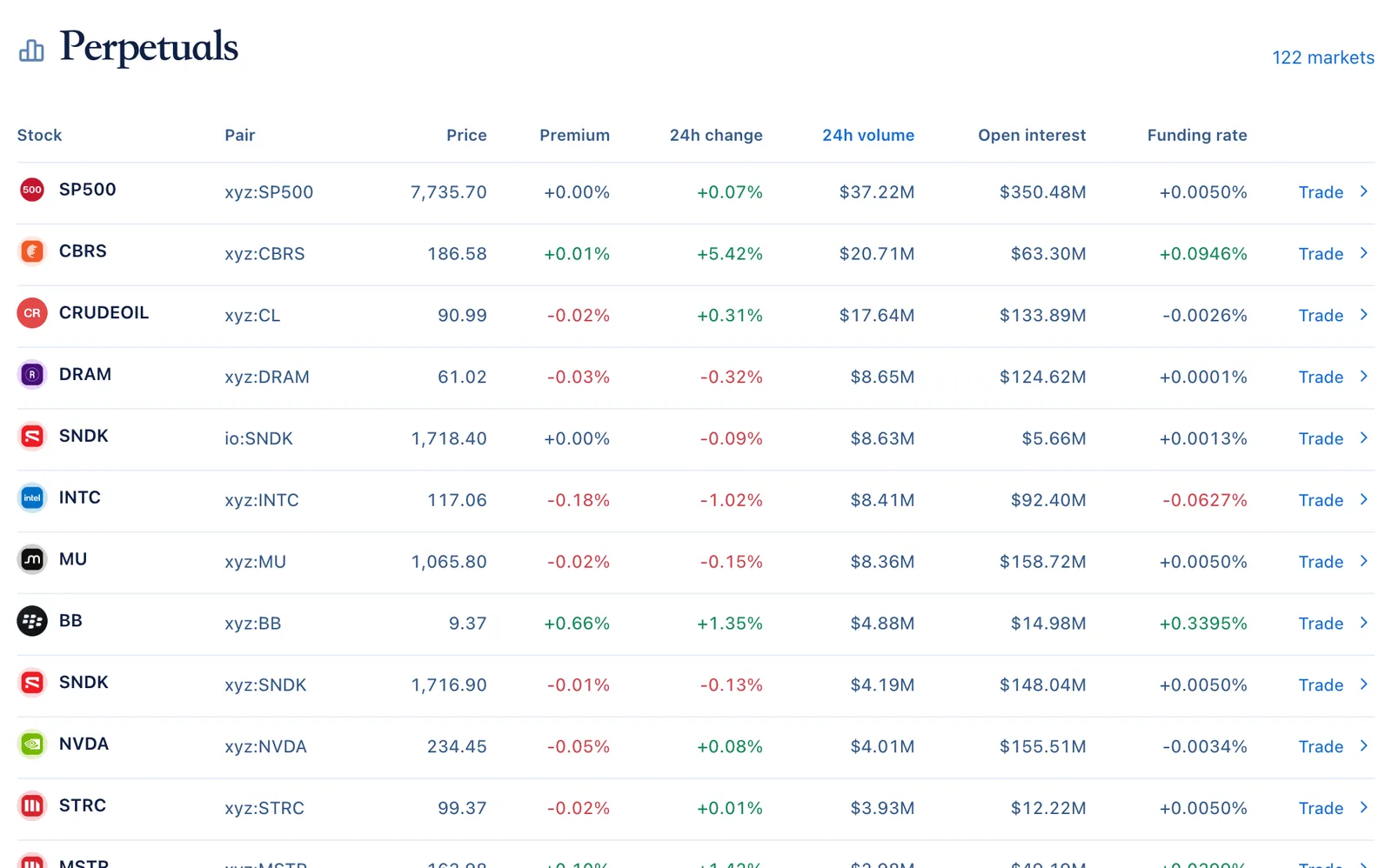
Among the venues we track, Hyperliquid is one of the most active places for stock and index perpetuals: when we captured the screenshot below, its S&P 500 contract traded more than $37 million in 24 hours, and stock contracts such as SNDK, Intel and Micron traded millions each. It differs from centralized exchanges in two big ways. You trade by connecting a wallet, with no account registration or identity verification. And the stock contracts are not listed by Hyperliquid itself; third parties deploy them under the HIP-3 rules. This guide explains where Hyperliquid's stock contracts come from, how to deposit and trade, how funding and fees work, and which risks to weigh first.
Regional restrictions come first
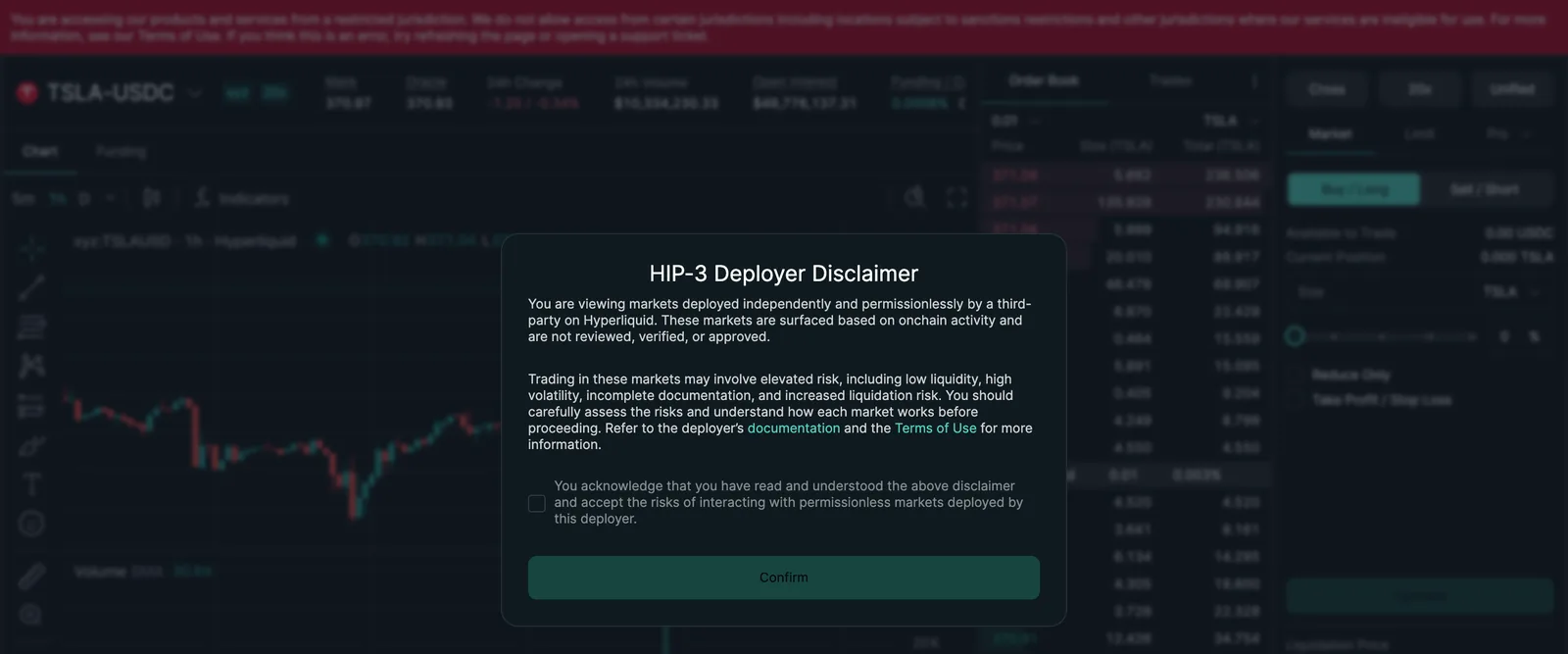
Hyperliquid does no identity verification, but that does not mean there are no regional limits. Its terms restrict users in the United States, Ontario (Canada) and sanctioned territories, and opening the site from a restricted network shows a red regional notice. Stock contracts are deployed by third parties such as trade.xyz, which have their own terms. You must also follow local rules on crypto and derivatives trading; see buying stock tokens by region.
Who issues the stock contracts on Hyperliquid
Hyperliquid is a blockchain built for trading, with matching, margin, funding and liquidation all handled on-chain. Through HIP-3 it lets third-party deployers open their own perpetual markets: a deployer stakes 500,000 HYPE, defines the contract specification, supplies oracle prices, sets leverage limits and can settle a market if needed, while matching and margining run on Hyperliquid's core infrastructure.
That is why stock contracts on Hyperliquid carry a prefix naming the deployer: xyz:TSLA and xyz:SP500 come from trade.xyz, while mkts:US500 and io:SNDK come from other deployers. The same stock can have contracts from several deployers with different quote units, leverage, fees and liquidity, so the name alone is not enough.
The first time you open a third-party market, Hyperliquid shows the HIP-3 deployer disclaimer: these markets are deployed independently, are not reviewed or approved by Hyperliquid, and may involve low liquidity, high volatility, incomplete documentation and liquidation risk. You must tick an acknowledgement before trading.
Preparing a wallet and funds
According to Hyperliquid's documentation, you can connect a standard EVM wallet (such as Rabby, MetaMask or Coinbase Wallet) or log in with an email address on the official site. With a wallet you need:
- An EVM wallet, with the recovery phrase stored safely offline; anyone with your phrase or private key can take your funds.
- USDC on Arbitrum, plus a little ETH for the deposit's network fee. The documentation lists other depositable assets too, which must be converted to USDC before trading USDC-quoted contracts.
- Some centralized exchanges and bridges support withdrawing directly to Hyperliquid; choose the right network.
To deposit, click Connect on app.hyperliquid.xyz, then Enable Trading and sign a gas-free authorization in your wallet; click Deposit, enter the USDC amount and confirm in the wallet. Hyperliquid notes that trading itself is gas-free; network fees apply only to deposits.
Placing an order
- Use the market selector to find the contract, paying attention to the prefix, for example trade.xyz's
xyz:TSLA. - Choose margin mode and leverage. trade.xyz's documentation says each market's default margin mode is listed in its specification index, that cross and isolated margin (including strict isolated, where margin cannot be withdrawn) are supported, and that leverage can be any integer from 1 to the market's maximum.
- Choose long or short and enter the size; position value is roughly margin times leverage.
- Place and confirm the order, then watch margin, unrealized PnL and the estimated liquidation price.
Where prices come from: market hours, off-hours and weekends
For trade.xyz, the largest deployer by volume, the documentation says:
- External price coverage: US stock contracts take external prices 24 hours a day, five days a week, from Sunday 8:00 PM to Friday 8:00 PM ET, combining pre-market, regular, after-hours and overnight sessions (overnight from Blue Ocean ATS).
- When external prices are unavailable, for example at weekends, the oracle starts from the last external price and adjusts toward the order book's impact prices with an exponentially weighted average using a 30-minute time constant, switching back as soon as external prices resume.
- Holidays: futures, metals and energy markets close for parts of external-market holidays, as listed in its holiday schedule.
So weekend prices are driven mainly by trading on Hyperliquid, and Monday's open can gap. See trading stock tokens at weekends.
Funding: settled every hour
Hyperliquid settles funding every hour at one eighth of the computed 8-hour rate; funding moves directly between longs and shorts and the venue takes no cut. Funding is capped at 4% per hour, much looser than centralized exchanges. Third-party markets use a more responsive premium formula, and deployers can set a funding multiplier and interest rate.
To compare with other venues, we show Hyperliquid's hourly rate converted to an 8-hour equivalent. To estimate holding costs, use the funding calculator with a one-hour interval.
Fees
trade.xyz's documentation says standard fees on HIP-3 markets are twice those of Hyperliquid's validator-operated perpetuals, split equally between Hyperliquid and the deployer. Some markets run in growth mode, with all-in fees cut by 90% or more. Fee tiers are based on 14-day weighted volume, and HYPE staking discounts apply. Rely on the rate shown when ordering.
Dividends and splits
trade.xyz says cash dividends do not ordinarily interrupt trading; perpetual holders do not receive dividends directly, and the dividend's economic effect shows up in price and funding through arbitrage with the shares. Splits and reverse splits change the share unit the contract tracks: existing positions are settled (closed at a settlement price, with profit or loss realized and orders cancelled), and the market reopens on the post-split basis. Watch the deployer's notices before holding through a corporate action.
Aster and other on-chain venues
We also track stock perpetuals on Aster. Like Hyperliquid, Aster is traded by connecting a wallet with no account, but its contract rules, fees and liquidity differ, and the same stock's contracts can trade at different prices. Our stock pages put Hyperliquid, Aster and centralized exchange contracts side by side so you can compare premium, volume and funding.
Risks to weigh first
- Deployer risk: the deployer is responsible for the specification, oracle and settlement, and rules can change. Deployers stake HYPE that can be slashed, but that is not compensation for traders.
- Wallet risk: you hold your own funds; a lost or stolen phrase cannot be recovered. Watch out for fake sites and malicious approvals.
- Leverage and liquidation: prices can jump past your liquidation level when markets are closed or at the open.
- Liquidity: volume concentrates in a few popular contracts; spreads on others can be wide.
Frequently asked questions
Does Hyperliquid require KYC?
No registration or identity verification is needed; you log in with a wallet or email. Its terms still restrict users in some regions.
What is the difference between xyz:TSLA and TSLA?
The xyz prefix means the market was deployed by trade.xyz. Hyperliquid's own markets cover crypto and other assets; third-party stock contracts carry the deployer prefix.
Why is mkts:US500 priced at a tenth of the S&P 500?
Deployers use different quote units, and mkts:US500 quotes a tenth of the index. Confirm the unit before comparing prices; our premium figures use each contract's own index, so units do not distort them.
Official sources and review date
Based on Hyperliquid's documentation on getting started, funding and HIP-3, and trade.xyz's documentation on US stock contracts, oracle prices, fees and corporate actions, reviewed on October 4, 2026. This guide explains the product and is not investment advice.