How to Trade Stock Tokens and Stock Perpetuals: Binance and OKX
A four-step illustrated guide to finding a stock, checking eligibility, choosing a product and reviewing costs, with separate paths for Binance bStocks spot tokens and OKX stock perpetuals.
Before trading an instrument linked to a US stock, check what you would actually hold. Binance bStocks are tokenized securities on a spot market. OKX stock perpetuals are derivative contracts with margin, funding and liquidation risk. Neither is the same as directly owning shares through a broker. This guide follows four steps (find the stock, check eligibility, choose a product, review costs) for each route, and lists the checks people most often skip before placing an order.
The four-step overview
- 01Find a stockSearch its ticker on Stocknas and open the stock page to see listed tokens, perpetuals and venues. Similar names do not mean the products are identical.
- 02Check eligibilityCheck local rules, the venue's terms, identity verification and access to the specific product. An exchange account alone does not guarantee access.
- 03Choose a productFor a token, read the issuer's terms and token rights. For a perpetual, understand margin, leverage and liquidation first.
- 04Review costs and risksVerify the pair, quote, fees, spread and liquidity in the order preview. For a perpetual, also check funding, leverage and estimated liquidation price.
Step one: see which products exist for the stock
Type a ticker or company name, such as "TSLA" or "Tesla", into the search box at the top of this site and open the stock page. The header shows how many venues list the stock, how many stock token and stock perpetual markets exist, and the reference price; below it is the venue-by-venue table.
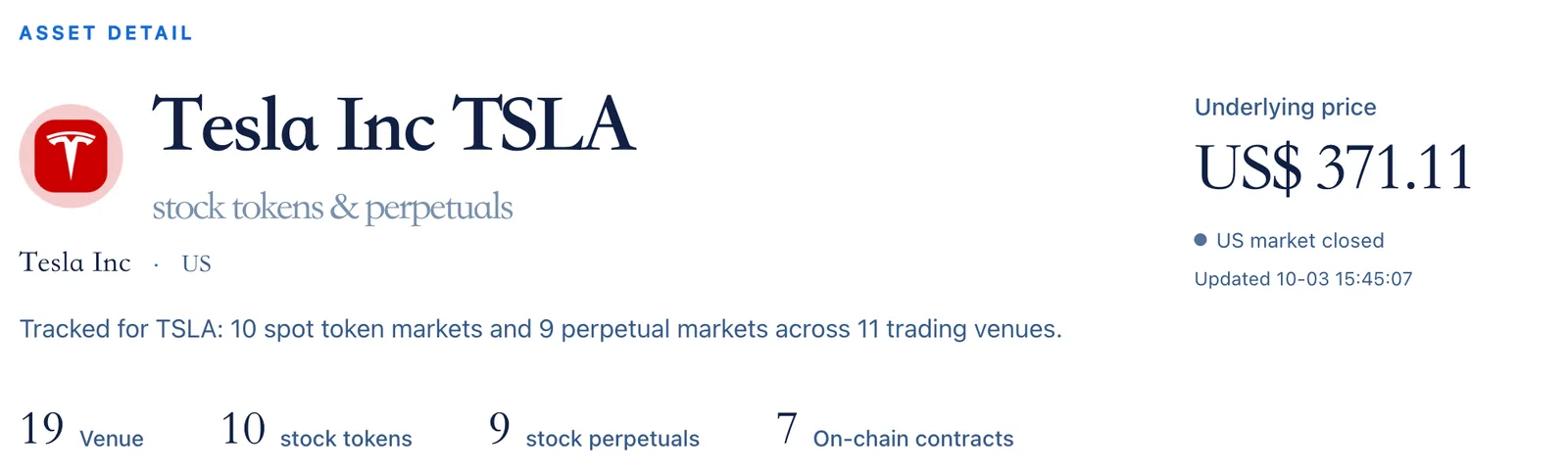
In the table's Type column, stock tokens and stock perpetuals are labelled separately, and token rows show the pair and series, for example TSLABUSDT · bStocks. Decide which kind you want before going to a venue.
How the two routes differ
| Question | Binance bStocks spot token | OKX stock perpetual |
|---|---|---|
| Product | Tokenized security on a spot market | Derivative contract |
| Example pair | TSLAB/USDT | TSLA-USDT-SWAP |
| Leverage | None (spot) | Yes, under the contract rules |
| Shorting | No | Yes |
| Holding cost | Trading fees, spread and premium | Trading fees, spread and periodic funding |
| Main risks | Price gaps, issuer and venue risk | Leveraged losses, liquidation, accumulating funding |
| Suits | Unleveraged positions held for a while | Short-term trading, hedging or shorting |
Route 1: Binance bStocks spot tokens
Binance lists bStocks on its spot market. The issuer, holder rights and eligible regions for each token follow Binance's and the issuer's latest terms. Holding bStocks is not the same as directly owning the company's shares and does not automatically confer shareholder rights.
- Confirm on Binance that your account and region are eligible for the bStocks product you want.
- Look up the token symbol on the Stocknas stock page, then check the full spot pair, issuer information and product description on Binance. Do not rely on the stock ticker alone.
- Before ordering, compare the venue's quote with the reference price and check shares per token, fees, spread and order depth. The reference may lag while the US market is closed.
- Read the order preview and risk notices before deciding; after a fill, check the product name and quantity in your holdings.
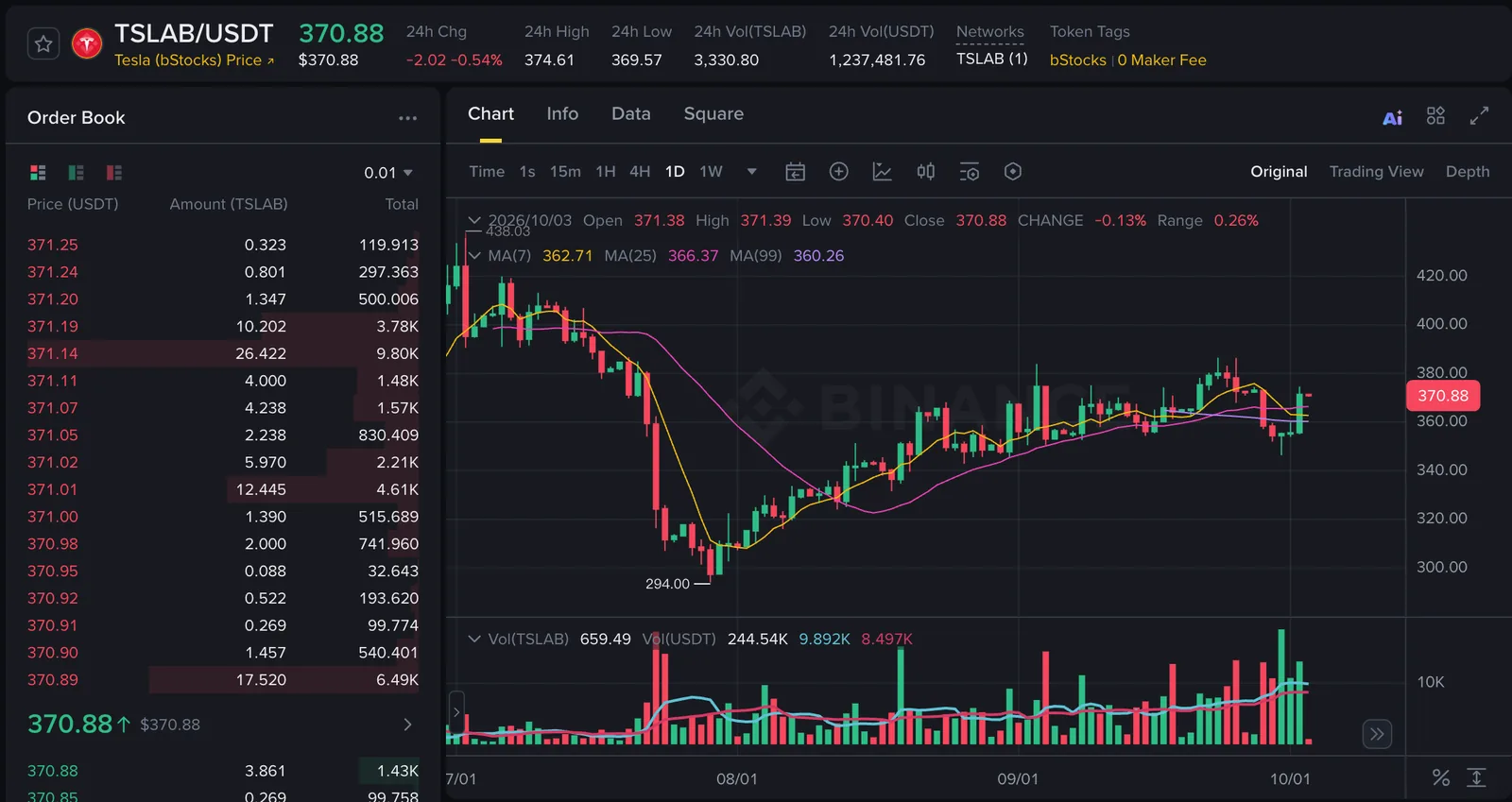
Two details matter when ordering. First, prefer limit orders: look at the best bid, best ask and size in the order book, set a price you accept, and avoid market orders that sweep several levels in a thin book. Second, note the quote currency: the pair is priced in USDT, so you need USDT in the account, and fills and fees are in USDT.
The stock-token premium calculator can help compare prices, but it does not replace the venue's live order quote. When preparing an account, use the Binance account setup guide and see Binance account options and regional terms.
Route 2: OKX stock perpetuals
OKX stock perpetuals are contract trading. A position is neither a share nor a withdrawable stock token. Its price is formed in the contract market and can deviate from the stock; leverage magnifies losses, and insufficient margin can trigger liquidation.
- Confirm that your region and account are eligible for OKX TradFi stock perpetuals.
- Find the stock contract in OKX's TradFi or futures section and check the contract code, quote currency, margin mode and trading rules.
- Before sizing a position, check leverage, required margin, funding rate and interval, fees, spread and estimated liquidation price.
- Recheck direction, size and risk in the order preview. After opening, keep watching margin and funding; a perpetual is not a hands-off long-term stockholding.
Margin is usually either cross or isolated. Cross margin uses your available balance to support all positions, so losses can spread; isolated margin limits the risk to the margin assigned to that position. Beginners generally do better starting with isolated margin and low leverage, keeping the maximum possible loss on any trade to an amount they accept.
To estimate holding costs, use the funding rate calculator and read how stock perpetual funding works, which explains each price on a perpetual trading page with a screenshot. When preparing an account, see OKX account options and regional terms and the OKX account-opening guide.
Five common mistakes
- Ordering by ticker alone: one ticker can mean a token, a contract or tokens from different issuers. Check the full pair and product description.
- Treating a contract as a long-term holding: perpetuals need ongoing margin management, and persistent positive funding keeps adding cost.
- Ignoring market hours: while the US market is closed, the reference can sit near the last close, so premiums and contract gaps are only indicative.
- High leverage over a weekend or earnings: an opening gap can jump straight past your liquidation price.
- Skipping the eligibility check: signing up does not mean you can trade a given product, and an account can be restricted later for regional reasons.
Final checks before trading
- Availability first: regional rules change. Rely on the venue's current product page and local rules; see the regional eligibility guide.
- Then the product: bStocks spot tokens and stock perpetuals carry different rights, costs and risks. Compare them with the stock-token introduction.
- Finally the order: the venue's live quote and fees are what count; our data is for comparison and may be delayed.
Frequently asked questions
Can I trade bStocks and stock perpetuals in the same account?
It depends on the venue. Binance spot and futures are separate account types and funds must be transferred between them; OKX also distinguishes account modes. Make sure funds are in the right account before ordering.
Can I move bStocks to another venue to sell?
Follow Binance's product description. Tokens that cannot be withdrawn on-chain or to other venues can only be sold on Binance.
Official sources
Based on the Binance bStocks announcement, the OKX stock perpetuals FAQ and the OKX perpetual trading guide as available on September 23, 2026, with screenshots captured on October 3, 2026. Listings, access and fees can change; rely on official information at the time of ordering. This guide explains procedures and is not investment advice.