Do Stock Tokens Pay Dividends? How xStocks and Ondo Reinvest Them
Stock token dividends are usually reinvested rather than paid in cash. How xStocks, Ondo, bStocks and perpetuals handle dividends, why high-yield tokens look like they trade at a premium, and withholding tax.
If you hold tokens for dividend-paying stocks such as Apple, McDonald's or Coca-Cola, do you get the dividends? It depends on the issuer and on what you hold. Most token issuers do not send cash to your account; they reinvest the dividend into the token. Perpetuals pay no dividends at all. This guide explains the common approaches, how they show up in prices and balances, and why tokens for high-yield stocks always seem to trade above the share price.
Tokens, perpetuals and shares: who gets what
| What you hold | Dividends? | How they show up |
|---|---|---|
| Shares at a broker | Yes | Cash after withholding tax, which you can choose to reinvest |
| xStocks tokens | Indirectly | Net dividends are converted into shares, so each token represents more shares |
| Ondo tokens | Indirectly | Net dividends are reinvested and reflected in the value each token represents |
| Exchange-specific tokens (such as bStocks) | Check the venue | See the venue's product page or announcements |
| Stock perpetuals | No | The contract tracks price only; ex-dividend handling depends on the venue's rules |
Three common approaches
1. Reinvested as more shares (xStocks)
After a dividend is paid, xStocks converts the net amount (after withholding tax) into shares, so each token represents slightly more stock. Your token count stays the same, but each token is backed by more shares and its value includes the dividend. The longer the product has existed and the higher the yield, the further shares per token move above 1.
Take McDonald's. When we captured the screenshot below, each MCDx token represented about 1.0212 shares: accumulated reinvested dividends added roughly 2.1% to the stock behind every token. The issuer writes this multiplier into the token contract on Solana and schedules a new value to take effect after each dividend; the figure published by exchanges such as Bybit matches the multiplier currently in effect on-chain. Our stock pages show it next to the trading pair as "1 token ≈ N shares" and use the on-chain multiplier when calculating the premium.
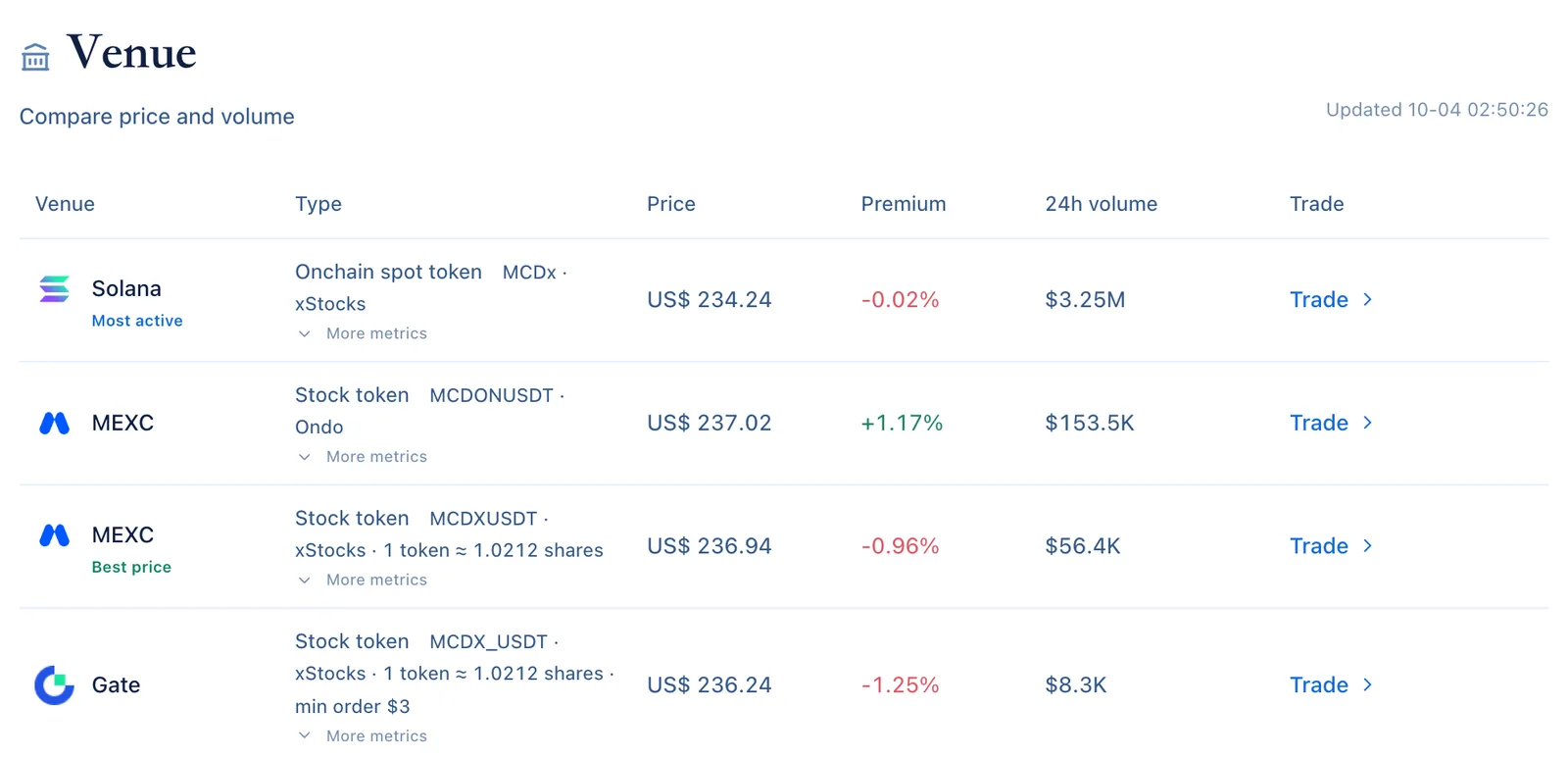
The same xStocks token is shown differently in different places. On a centralized exchange, the token count stays fixed and each token represents more than one share. On Solana, xStocks uses a token extension that reflects the change in the wallet's displayed balance: the balance grows slightly as dividends are reinvested, and the price per displayed unit stays close to the price of one share. That is why on-chain MCDx trades near the share price while MCDX on an exchange that quotes per token, such as Bybit, trades roughly 1.5–2% above it. Thinly traded venues may not follow this ratio closely, so compare with the most active ones.
2. Reflected in the token's value (Ondo)
Ondo's stock tokens also reinvest dividends, but the effect shows up in the value each token represents rather than in cash or a larger balance. The token price gradually rises above the share price by roughly the accumulated net dividends. In the screenshot, the Ondo pair MCDONUSDT shows a "premium" of about 1.2%, most of which is this accumulated dividend rather than an overpayment.
Because most venues do not publish how many shares an Ondo token represents, we cannot normalize it precisely. Its displayed premium therefore includes the dividend component, and Ondo tokens are kept out of our premium rankings to avoid misleading comparisons.
3. Check the venue (bStocks and others)
For tokens launched by an exchange, such as Binance bStocks, follow the venue's product description. Before buying, check on the token's detail page or in announcements whether dividends are paid, in what form and on which date adjustments happen.
Stock perpetuals pay no dividends
A stock perpetual only tracks price. Holding it does not mean holding the stock, so you receive no dividends. On the ex-dividend date the share price drops by roughly the dividend and the index and contract move with it. Venues handle this differently: some make no adjustment, so the drop simply shows up in both sides' profit and loss; others adjust the contract under their rules. Bybit, for example, says it adjusts TradFi perpetuals for corporate actions such as cash dividends and splits, while stressing that this reflects the action's effect on the contract and does not mean holders receive a dividend. Before holding a contract on a high-yield stock through an ex-dividend date, check your venue's contract rules. For long-term long exposure to a high-yield stock, a token and a perpetual can produce different results.
Why high-yield tokens seem to carry a premium
If you compare a token's price directly with the share price, reinvested dividends look like a premium. For a stock yielding 3%, a token one year after issue may represent about 1.03 shares and trade about 3% above the stock. That is not money you overpaid: when you sell, you also sell 1.03 shares' worth.
The correct comparison normalizes by shares per token first:
Normalized premium = token price ÷ (share price × shares per token) − 1
We use published share counts when calculating premiums. Tokens without a published or confirmable figure stay out of the premium rankings. To check a token yourself, enter its price, the share price and the shares per token in the stock token premium calculator.
Withholding tax
US companies generally withhold 30% of dividends paid to non-US investors, and a lower treaty rate may apply in some jurisdictions. Token dividends are usually taxed at the issuer level before reinvestment, so the effective rate depends on the issuer's arrangements and jurisdiction, not on where you live. The dividends accumulated in a token can therefore be somewhat lower than what you would receive in a brokerage account for the same stock. Ask a local professional about your own reporting obligations.
Checklist before buying tokens for a high-yield stock
- Identify the issuer: xStocks, Ondo or an exchange-specific token, since each handles dividends differently.
- Find shares per token: does the venue publish it, and does our venue table show "1 token ≈ N shares"?
- Normalize by shares before comparing prices, so accumulated dividends are not mistaken for a premium.
- For long holding periods, prefer a token that reinvests dividends over a perpetual.
- Understand the issuer's withholding arrangements to estimate how much of the dividend actually reaches the token.
Frequently asked questions
Why did my xStocks balance increase?
That is how xStocks shows reinvested dividends on Solana: the displayed balance is adjusted to the new share count. You did not receive a transfer; the same holding now represents more stock.
Do I get the reinvested dividends back when I sell?
Yes. They are part of the token's value, so a sale at the market price includes them, provided the market price correctly reflects the share count. Check the premium before you sell as well.
Do short perpetual positions pay dividends?
No. Perpetuals pay no dividends, and shorts do not owe dividends as they would when borrowing shares. How an ex-dividend price change affects a position depends on whether the venue adjusts the contract; follow the venue's rules.
Summary
- xStocks and Ondo usually reinvest dividends into the token rather than paying cash.
- Reinvestment increases the shares or value each token represents, so normalize by shares when comparing prices.
- Perpetuals pay no dividends, and whether contracts are adjusted around ex-dividend dates depends on the venue; exchange-specific tokens follow the venue's rules.
This guide explains dividend mechanics and is not investment or tax advice.